Episode 7 is so full of quotable lines, it’s hard not to just list them all here, suffice to say that Jessica Lange gets to say almost all of them: “I didn’t get my start in the theater like Miss Bette Davis. I broke in shaking my fringe in nightclubs. I’d come home after a gig with Scotch on my dress and I’ll always have that stain on me and I’ll always have to prove them wrong and I can’t do it on Charlotte because she won’t let me!”
Jessica Lange does this thing with her voice when she’s playing characters about to blow up, where the whole line is delivered under (rising) pressure and then words suddenly blast out like steam escaping from a cracked valve. It’s extremely unnerving. And frankly terrifying.
It’s also poetically symmetrical: Joan Crawford was at her best in confrontation scenes where she could be righteously indignant, her body frozen like a cobra, wide eyes fixed on her accuser, somehow unblinking even while tear-filled, with only the quiet, steady heaving of her chest to indicate the depth of her unspent fury. Even in Adrian gowns and three pairs of false eyelashes, something raw was happening in those confrontation scenes. The actress—not the character— was connecting with some very real sense of having been wounded, judged unfairly, cheated, ripped off, and sublimating it into performance-exorcism.
Lange is the same kind of witch, and this installment of Feud gives her many opportunities to stir her cauldron of haunts and hurts. Not least when she discovers, as shooting on Hush Hush Sweet Charlotte progresses, that Bette—now a producer on the film—intends to exploit every opportunity to critique Joan’s acting, cut back all her dialogue, make fun of her at the wrap parties and generally wreak snarky havoc whenever possible (presumably as payback for that little Oscar thing…)
Director Aldrich thinks she’s a scream (but he’s in punch-drunk divorce throes) and the rest of the crew laughs ass-kissingly along, but Victor Buono (playing Bette’s father in Charlotte) thinks it’s distasteful, and actually has the balls to tell Bette so: “You should be nice.” But Bette’s not finished. The next day she rejects an olive branch when Joan volunteers to stick around for Bette’s close-ups and deliver her lines to her (since the dawn of film-making, actors who volunteer this have been praised and revered for the inherent generosity of the act and encouraging a sense of camaraderie with their co-stars.) To turn down this offer would thus have been equivalent to saying “No thank you. I’d rather compete with you than be your friend.”
Things get worse for Crawford when she wakes up in the middle of the night to discover her trailer is the only one left. Everyone else has returned to the hotel without her. Storming back with Mamacita in a taxi, she bangs on Davis’ door and lets her have it. “What a fool I was to think I could trust you!” Bette of course just shrugs off the accusations until Joan retreats, but not without a few last barbs, each actress appraising the others’ shortcomings with an assessment we’ve all heard before: Davis was the actress, Crawford just a movie star. But before they part ways, a moment of connection: “Joan. What was it like being the most beautiful girl in the world?” “It was wonderful” beams Crawford earnestly, the wind teasing her disheveled hair. “It was the most joyous feeling you could ever imagine. And it was never enough…..And you? What was it like being the most talented girl in the world?”
“It was great,” replies Bette wistfully. “And it was never enough.”
This fleeting moment can’t last, of course, and when Joan discovers the next morning that script revisions have eliminated yet more of her monologues, it’s no more Mr. Nice Girl. “I suddenly feel very ill,” she says to the driver. “Take me to the hospital please.”
“She’s not sick, she’s on strike until Bob accepts all her loony script changes and makes her the star of Charlotte” snipes a disgusted Bette. In any case, they shoot around her, but after 12 days, Aldrich is out of things to shoot and has had enough. He comes to tell Joan she’d better be back on set the next morning or the picture will be scrapped.
Joan arrives in a wheelchair, and Bette presents her with a single red rose: “I’ve taken out the thorns.” (But has she?) Joan tries a power-play and starts making suggestions for beefing up her part as Cousin Miriam. “There should be a ball in her honor when she returns home.” Aldrich argues that Charlotte is a recluse. “She wouldn’t be hosting a ball, Joan.” “I’m not suggesting the host it,” replies Crawford. “She can be there of course. In a corner. Hidden under the stairs, watching. All we see are her big eyes….” (I freely admit to laughing out loud at that speech). No, that rose was too little too late.
Long story short, Joan goes back “on strike” and returns to the hospital, only Aldrich & Co. call her bluff, not only replacing her with Olivia de Havilland (Joan hears about this on the radio) but slapping her with a lawsuit to boot. Then it happens; she throws that one vase too many at Mamacita’s head, who honors her previous warning and walks out. Oddly, the scene ends with Joan in an oxygen tent, even though her illness was formerly only strategic. Maybe the trauma of being abandoned by her only real ally was enough to make her sick for real?
Meanwhile, tensions between Bette and daughter BD are coming to a head when Bette takes control of 16-year-old BD’s wedding (to 29-year-old Jeremy Hyman). To her surprise, instead of a “thank you,” she gets the “you’re not doing this for me, you’re doing it for YOU!” speech.
Likewise, Aldrich’s faithful Pauline has had her fill of egomaniacs and vows to retire, with the brilliant parting line, “I don’t know if this town attracts narcissists, or if it actually creates them.” So Bette, Aldrich and de Havilland go off to finish their movie, and Joan returns, Mamacita-less, to her emptier-than-ever nest, and an uncertain future.
Pet Moment: Joan autographing a photo of herself holding Anne Bancroft’s Oscar.
Pet Crawford Line: “The only bed I can find any power in is this hospital bed!”
Pet Davis Line: “Who would believe Vivien Leigh as a Southern Belle?” (Aldrich: “She played Scarlett O’Hara!”) Davis: “UN-convincingly!
Pet de Havilland Line (from Lady in a Cage preview) “Please help! I’m trapped in a small, private elevator!”
]]>Okay, any episode that opens with an axe-wielding Jessica Lange reenacting scenes from Strait Jacket (Joan Crawford’s 1964 B-movie campfest) gets my vote for best installment of any show ever. There’s something indescribably sublime about seeing talented actors painstakingly recreate sheer crap (albeit wildly entertaining crap). And when Feud reconstructs, they get it right, down to the wallpaper.
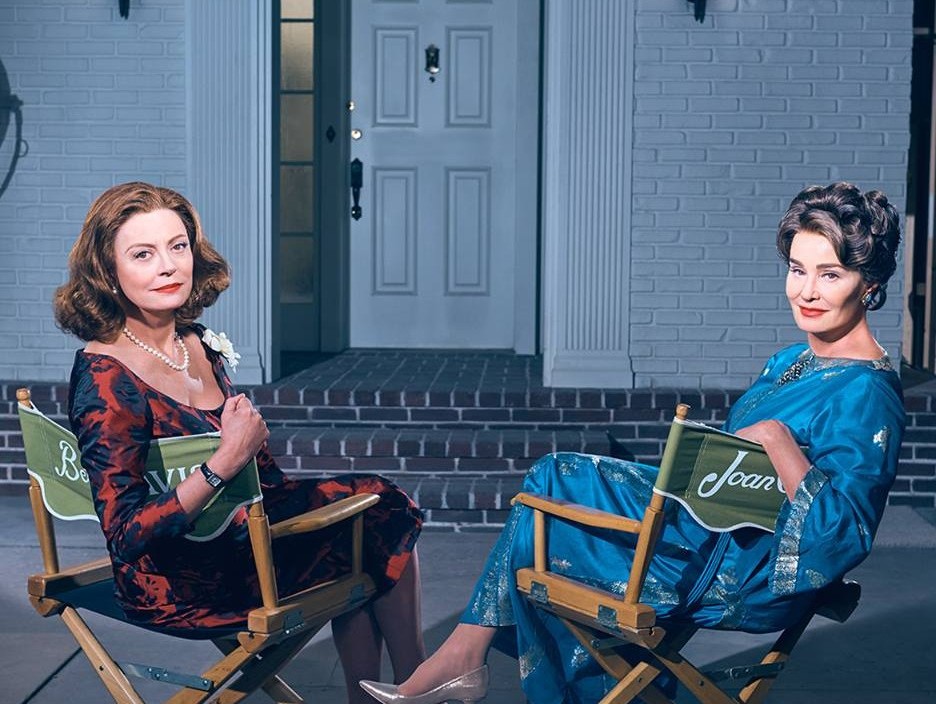
What emerges in Episode 6 is just how many feuds are actually in the air at once. Bette wants Joan dead for campaigning against her in the Oscars. Joan wants Bette’s blood for being nominated in the first place. Studio head Jack Warner wants to keep director Robert Aldrich in a state of eunuch-like subservience, but Aldrich is tired of serfdom. Meanwhile, the erstwhile-devoted Mamacita is fed up with having vases flung at her head every time Joan has a bad day, and offers an ultimatum. One more vase and she’s out of there.
Finally, we have Bette and Joan wrestling with the industry and the evolving movie-going public itself. The industry—in its carnival barking way, wants to reduce the success of Whatever Happened to Baby Jane? to “hagsploitation” formulas in which, to paraphrase Warner, you take a former female movie legend freshly tumbled from her pantheon, and desecrate her in a degrading format designed for viewers to see both character and actress suffer. “Tear down your idols…this is very satisfying to an audience,” he muses.
Meanwhile, Bette and Joan don’t understand why everyone’s ignoring the concept of just making GOOD movies with parts for older women.
Power surges are the motif of Feud—everybody’s in a wrestling match grappling for more control. And at the end of the day, what they’re all trying to get is respect, And the only reason they can’t have it is because no one trusts each other enough to take off the gloves. It’s a house of cards (and an O. Henry-worthy irony).
After the aforementioned series of painstakingly reenacted previews for Strait-Jacket, along, with a howler of a scene depicting a typical promo tour appearance with William Castle (John Waters—who else?) we’re off and running as Aldrich woos Bette and then Joan (in a brilliantly cross-cut scene) into agreeing to reunite for one more round.
The Emmy noms practically fly off the screen as the montage gives Lange and Sarandon ample opportunity to shade their characters (Lange especially), and highlights just how well this thing is written. Really, Feud could have been half as good as this and still qualified as quality entertainment.
Anyway, filming for Baby Jane: Part 2 Hush Hush Sweet Charlotte gets underway, but not before another scathingly brilliant face-off between Warner and Aldrich, who has come to give Jack the kiss-off. He’s just signed with Warner nemesis Daryl Zanuck to make Charlotte for 20th Century Fox instead of Warner. “I’ve come to get my balls back….hear ‘em clankin’?” gloats Aldrich. “Give me back my cigar!” sputters a wounded Warner.
Next thing you know, creepy Hedda comes a-calling at Crawford’s house with the glad news that someone’s got hold of a “blue movie” featuring an actress who looks an awful lot like pre-Hollywood Joan. She wants an exclusive quote, but Joan’s more interested in having a chat with the sure-fire source of the rumor—her traitorous brother Hal, a washed-up tried-to-be-actor, now unhappily employed as a hotel clerk. Joan tries an economy pay-off but Hal wants more. We find out that Hal was Mama’s favorite and Joan was the daughter no one wanted. A lifetime of bitter rivalry is indicated—yet another “feud”.
Then Aldrich’s wife Harriet—fed up with the back of his head—asks for a divorce. Another great speech: “You never stopped having a life. I don’t know when I lost mine. But I’m getting it back…only not with you.” Molly Price delivers the haiku-like farewell speech with artful weary restraint. It’s a resignation AND an emancipation, with flickers of all the repressed messiness and exhilaration that both words imply.
Meanwhile, on a Baton Rouge Plantation, Bette and Joan have agreed—once again—to a temporary truce, but tempers flare as they both steamroll Aldrich (and then each other) in twin efforts to gain control. The point is not that they are difficult people just to ruin your day. They’re fighting not to be made into clowns by the men who are calling them “hags” behind their backs. Who, if anyone, will triumph?
Can they finish Charlotte without killing each other? Will Joan throw another vase at Mamacita? Will Hal’s sudden death (spoiler alert–he dies undergoing an appendectomy) halt the release of the dreaded blue movie? And most importantly, will Joan’s bank be able to stop payment on Hal’s blackmail check before his estate can cash it?
The answer to these and other questions in Episode 7.
Feud airs Sundays at 10 EST on FX.
]]>Shit just got real. Or, to put it another way, this is the first installment of Feud that features an event that undeniably happened.
Up until now, the fireworks have all been of the “may have” and “was rumored to” variety, but it’s really, really true that—snubbed by the Academy for an Oscar nomination (Bette and Joan had shared lead billing in Whatever Happened to Baby Jane?, making both eligible for the “Best Actress” honor)—Joan campaigned not only to be a presenter, but to accept the award for any Best Actress nominee who could not attend. Touché!
Naturally, Feud frames this stealth maneuver as a solely anti-Bette gesture (although whether Crawford actively tried to keep Davis from winning is unsubstantiated). Personally, I think Battleship Joan was aiming her torpedoes at a larger target—the industry in general. “They can refuse to acknowledge me,” one can almost hear her thinking, “but by God, my ass will be on that stage and holding that award!” And if it happened to put a thorn in Bette’s side in the process, even better! Whichever scenario you believe, Feud makes delicious fun of speculating.
Re-enter ubiquitous lizard Hedda Hopper, to help Joan hatch the Great Oscars Siege Hedda’s out for herself, as usual, but Feud teases us with occasional hints of a genuine bond between the two women. (Can I just stop for one moment to mention that Hedda must have been an adroit gate-climber, as she spends a LOT of time showing up unannounced at Joan’s front door?) Anyway, their diabolical plan goes without a hitch; Like clockwork, Anne Bancroft takes the bait and agrees to let Joan accept for her, then wins the Oscar, and presto! There’s Joan, breezing by a sucker-punched Davis on her way to the stage, resplendent in silver gown, silver hair, silver everything, as if she herself is an award.
Note: There’s a tracking shot to die for in this sequence that follows Joan in a circle as she leaves the stage from presenting Best Director, escorts him offstage and deposits him in the green room and without ever stopping, continues right back to the stage to accept for Best Actress, as the orchestra bleats out a version of “Mocking Bird” that sounds for all the world like it was arranged to drive Bette Davis insane. It’s a visually simple sequence, but unexpected. And quietly masterful.
A beaming Crawford delivers Bancroft’s acceptance speech and poses with the other winners, indistinguishable from them—radiant, triumphant. The newsreels, the morning paper, all show Crawford clutching the Best Actress Oscar. For all practical purposes, the winner. Yes, there’s nothing quite like skullduggery to balance the scales of justice! Score one for Joan. Davis (we can only assume) vows nicotine-stained revenge.
But hurry, Bette. You’ve only got three episodes left!
Feud airs Sundays at 10 p.m. EST on FX
]]>
The fourth installment of Feud finds Bette and Joan having wrapped filming on Whatever Happened To Baby Jane? and both experiencing a dearth of other offers, as the industry clearly anticipates the film to be a B-movie bomb. Bette’s agent disappears behind a curtain to be replaced by an “almost 23 year-old”. “Almost…23…” says Bette as she stares into the distance and sucks the life out of her cigarette. It’s hilarious and sad at the same time.
Joan fires an entire boardroom of agents at William Morris in a scene that recalls the “Don’t fuck with me fellas” howler from Mommie Dearest. You find yourself chuckling and admiring the tenacity of these women at the same time.
Bette even puts a tongue-in-cheek (but probably purposeful) “situation wanted” ad in the Hollywood Reporter looking for work. Meanwhile, gossip rag vulture Hedda Hopper continues to bait Joan’s paranoia that she’ll be snubbed at the Oscars, even while studio head Jack Warner (a spot-on Stanley Tucci) savagely beats down director Robert Aldrich’s hopes of being a great director, presumably as a means of keeping him at heel to do a profitable (but derivative and barely disguised) Baby Jane sequel.
“Alright, go be challenged”, he says. “You’ll be back. And I’ll probably take your call. You know why? Because I have a soft spot for losers.” Everybody’s savage in this movie. They could have called it The Jungle Book without much of a stretch. It’s survival of the fittest, and only the toughest survive all the mind games and power plays. Money talks and everything else hobbles away to bleed out.
The only genuine camaraderie so far is the unlikely union of Aldrich’s and Crawford’s two Girl Fridays, excellently played by Alison Wright and Jackie Hoffman, respectively. When Aldrich’s assistant Pauline writes a script for Crawford for a film she hopes to direct, and Joan’s faithful watchdog “Mamacita” (she’s German—get it? Me neither!) not only sings its praises to Joan but delivers a long speech that amounts to a feminist manifesto. In a series where everybody’s looking out for Number One, it’s nice to have this moment of somebody helping somebody without a personal agenda.
Alas, Joan refuses to read the script, explaining: “I’m not turning you down because you’re a woman. I’m turning you down because you’re a nobody. At this stage in my career, I’m not in the position to have the luxury of putting myself in the hands of a nobody. I have very few chances left. My last one is not going to be your first. I hope you understand that.”
Surprisingly, a teary-eyed but understanding Pauline returns to Aldrich’s side just as the last of his ego has been squished by an exceptionally pungent and snotty Frank Sinatra (who Aldrich is attempting to direct in a western). Aldrich takes his rage out on Pauline, telling her he doesn’t have time for her script or her dreams and to take a walk if she doesn’t like it.
Highlight: Susan Sarandon reenacting Bette’s TV appearance on The Andy Williams Show in which she sings a camp “theme song” (inappropriately go-go-ish), about what really happened to Baby Jane. Alas, Sarandon just cannot bring herself to replicate the awful sound that was Davis’s singing voice, but the visual, for those who have seen the original, is dead-on (just Google “Bette Davis Andy Williams” if you need proof). I don’t know why, but these reenactments are sublime.
The episode ends with Mamacita entering Joan’s room with the morning paper announcing the Oscar nominations for 1962. We don’t hear what she says. Just an exterior shot of the palatial estate. And a blood-curdling scream as the credits roll!
Feud airs Sundays at 10 p.m. ET on FX
]]>
This installment continues to track both the progress of the Whatever Happened to Baby Jane? shoot, and the levels of admiration and antagonism Bette Davis and Joan Crawford feel for each other–both rising in equal measure like twin thermometers. Gossip columnist Hedda Hopper is shown goading each star toward public slander of the other. She, after all, has papers to sell (Judy Davis’ over the top performance is deliciously cartoonish. And I don’t think it’s by accident that the costume designer has fashioned some of her hats to resemble a vulture). Crawford is shown trying to resist “being small”, but Hopper eventually wears her down. Bette Davis, on the other hand, sees through Hopper’s hyena-like motives. In one of Susan Sarandon’s better scenes this week, Bette refuses to badmouth Crawford and opts to tell Hopper exactly what she thinks of HER: “Joan’s an institution? She BELONGS in one if she thinks YOU’RE her friend!”
It’s a satisfying moment–not unlike seeing a kid suddenly defend the sister she’s always teasing. And it comes close, I think, to the heart of Feud, which is that underneath it all, we aren’t supposed to believe these two women hate each other. But, like Scarlett and Rhett in Gone With the Wind, they just can never seem to meet when they both have their defenses down at the same time, which creates a tension that is sometimes fun and sometimes exasperating.
Other plot points–Bette gets director Aldrich to give her talent-free daughter. B.D., a small role as the neighbor’s daughter, and much is made of B.D.’s inability to act. In the real-life version of the movie, she is not that bad—B-movie-ish, perhaps, but not atrocious as in Feud. Joan wears falsies for her dying scene on the beach and keeps sneaking into her trailer to make herself look younger when the scene calls for her to be corpse-like. Jack Warner (Stanley Tucci) orders retakes (“every time they cut back to her, she looks like she’s getting better! It’s like fucking ‘Camille’ in reverse!”)
Meanwhile, big gay Victor Buono (Dominic Burgess) gets mistaken for Charles Laughton by an actor wannabe who’s willing to trade sex for a chance at fame. Too bad the casting couch is a porno theater that gets raided during the “audition.” “There’s been a mistake, I was looking for the gas station,” mumbles Buono as he stumbles out of the theater and into custody. Bette, who has forgiven him his gargantuan size once his talent became evident, bails him out.
Joan is shown with her twin daughters Cathy and Cynthia, struggling with whether to send flowers and a note to eldest daughter Christina (future author of THAT book) for her debut in a play. It’s a scene meant to indicate the strain that existed between mother and daughter and restores a handful of shades to the “Tom and Jerry”-like caricatures outlined in Christina’s memoir Mommie Dearest. I have to give Feud points for this.
On the whole, Lange is much more consistent in her characterization of Crawford than Sarandon, who is all over the map in this episode. It’s as if she’s thrown, to a degree, by the dialect–as if not being able to speak in her voice is somehow so distracting that it disrupts her very ability to deliver a solid character. From line to line, she seems to struggle with whether to try for the voice, to ignore it altogether, or just to switch to concentrating on the famous facial tics instead. I like Susan Sarandon as an actress, but it appears that she needs to play “herself as….” to feel the role. A mimic, she ain’t.
Still, Sarandon looks great; it’s fun to watch her flounce around and reenact scenes from Baby Jane”(sometimes flawlessly, sometimes WTF-ishly), and to paraphrase one of her own lines to Crawford, in the pilot: When she’s good, dammit, she’s good. But I don’t see an Emmy nomination in her future. Lange, maybe….
Feud airs Sundays at 10 p.m. ET on FX.
]]>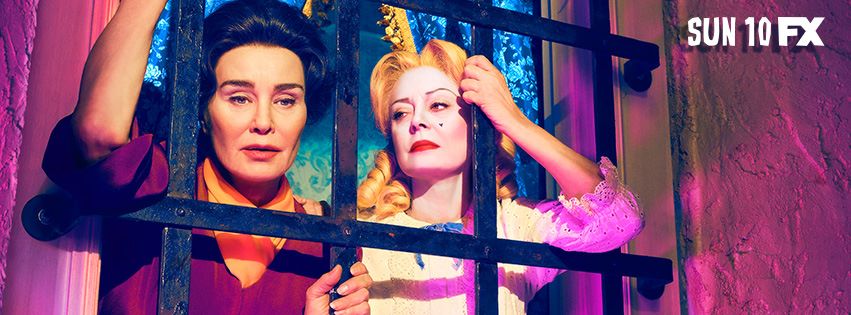
Bette Davis and Joan Crawford were the O.G. Original silver screen divas and their legendary beef is chronicled in the juicy miniseries Feud. TVRD’s Special Contributor, film director Scott Coblio, shares his take. — Elaine F.
The second installment of FX’s Feud continues the writer’s (seeming) purpose to clarify that the famous feud with Bette Davis and Joan Crawford was at least in part, the result of the actresses having been pitted against one another, not just on the Whatever Happened to Baby Jane? set, but through the decades, by various parties, and for various seedy purposes. This may come as a disappointment to some and a relief to others, depending on whether one prefers Bette and Joan as complex women or straight-up Disney witches. The show aims for the former but sprinkles just enough of the latter throughout to satisfy both demands.
In this episode, we see the continuation of Baby Jane shooting, learn more about Bette’s relationship with her teenage daughter B.D. (whom she totes to and from work like a purse), and the growing animosity that would one day produce a nasty tell-all book (in the Mommie Dearest mold) called My Mother’s Keeper. Whether it was accurate or not, the book, clearly surprised Davis and broke her heart). The filmmakers deserve credit for their avoidance of polarizing characters into victims and villains. No one in Feud is totally innocent. B.D. may be unnecessarily cruel when she says to her mom, “you see me being young and having fun, and you can’t take it because your turn is up!” But then, Bette has just been seen dragging her daughter offset in a huff, threatening to send her away “for the WHOLE summer!”, seemingly for no other reason than because she was attracting the attention of the male film crew.
The scruples of both actresses come under more scrutiny in this episode as they are seen using sex as a weapon to control their director Robert Aldrich (played with expert restraint by Alfred Molina). Aldrich, for his part, has no scruples either, as his wife makes clear when she lets him know that his casual extramarital affairs aren’t the well-kept secret he imagined. In fact, the subject of sex-as-currency comes up a lot in Feud and seems to be more a comment on the times and the industry than the characters themselves. The apparent maxim is: “This is the game—if you want to win, play by the rules or go home.”
One of the best parts of Feud is the accuracy with which the producers have managed to recreate well-known scenes from Baby Jane. I imagine that eventual split-screen comparisons will soon find their way to YouTube at some point after all the episodes have aired (I hear production on Jane wraps up next episode, so only one more installment before the reenactments are no more). It will be interesting to see how they will stretch the plot for five more episodes after production of Baby Jane wraps.
Production values continue to amaze as before. Costumes, sets, art direction, hair, etc. really are top notch, and I’m sure we’ll see a lot of Emmy/Golden Globe nominations for this show. Acting-wise, Stanley Tucci as studio mogul Jack Warner and Judy Davis as gossip columnist Hedda Hopper are all but stealing the show out from under Lange and Sarandon. Between the leads, I think Lange as Crawford is giving a more layered performance. But it’s fun to watch Sarandon chew the scenery as Bette, with her flashing eyes, furious cigarette-puffing, and “pelvis first” method of getting from place to place.
All in all, I still love it. If Episode 2 was not ultimately as fun as last week’s, it’s more because the emerging message, as it comes into deeper focus, is a rather sad one. That if not for all the outside meddling (and to paraphrase a line from Baby Jane), “all that time they could have been friends…”
Feud airs Sundays at 10 p.m. ET on FX
]]>
I love Susan Sarandon (bad political advice, aside) and Jessica Lange, so naturally I got excited when I heard about Feud–an FX miniseries about Joan Crawford and Bette Davis’s legendary animosity for each other (which I have always suspected was part fantasy—after all, outside of some comments Davis made (regarding Joan’s eager request to accept the Best Actress Oscar for anyone who won against Bette that year), neither actress ever spoke that poorly of the other—on record, at least. And much of the really nasty hearsay could easily have been made up—it’s pedigree is, at best, dubious. But it’s so much more fun to watch the one film they made together– Whatever Happened to Baby Jane? — when one imagines the depraved onscreen rivalry mirrored in real life!
Over the years, writers have devoted much ink to this legend. As the demand for more dirt grew, more and more people started coming out of the woodwork “remembering” things… until finally, it had become impossible to know what was real and what was fiction. Did these two women really despise each other? Or is it all the wet dream of bloodthirsty hyenas? Feud—an eight-part miniseries attempts to break it down for us.
Episode One establishes the premise: Our two ladies of cinema’s yesteryear find themselves pretty much stranded in 1962, each in their 50s and with matching moribund careers. Determined to stay in the game, Crawford takes the initiative to find a property suitable for herself and her old Warner Bros. rival, Bette Davis. She imagines that by teaming up (for the first time), the novelty factor of two old powerhouses sharing the screen will be too much for producers (and audiences) to resist. She was right of course because the property in question was the Henry Farrell novel, Whatever Happened to Baby Jane? Think Sunset Boulevard gone haywire—with not one but two Norma Desmonds, duking it out in their old Hollywood mansion. Bette accepts, agreeing to play the titular role of charismatically grotesque Baby Jane Hudson (with Crawford as her long-suffering, wheelchair-bound sister Blanche), and boom– we’re off to the races.
Immediately apparent in Feud, are the top-notch production values. Sets, cars, hair and makeup are all masterful, as is the supporting cast (Stanley Tucci, Catherine Zeta-Jones, Kathy Bates, Judy Davis). It’s intelligently written and nowhere nearly as camp as expected. It’s wildly speculative, of course, but then it would be boring if it wasn’t.
Are Lange and Sarandon dead ringers (no pun intended) for their real-life avatars? Kind of, if you squint your eyes a lot. Sarandon looks quite a bit younger (even though she’s almost 20 years older) than Davis was in 1962. She looks more like Margo Channing in All About Eve, from 12 years before. But that’s fine. It’s a great look. She’s clearly studied Davis’s movements and facial expressions more than her voice. Except for a random scattering of clipped phrases rendered with Bette’s idiosyncratic pronunciations, Sarandon uses her own voice and dispenses with mimicry. Once you let go of the need to hear that magnificent croak, it’s fine.
For her part, Lange has also studied Crawford’s sweeping grandiosity more than her facial expressions or vocal tics. Without hamming it up, Lange very subtly exposes the wounded and complex Texas hoofer behind the glacial mask of studied gentility that was Joan Crawford. She too avoids simple caricature.
As far as I can clock it, the writer’s perspective is that Joan–outside of simply wanting a hit movie to restore her career– is motivated by a craving for Bette’s stamp of approval, (supposedly since their 1940s heyday) and Davis is like the competitive older sister who can’t resist withholding it. She thinks Joan silly and artificial, and probably harbors some professional jealousy (Joan won an Oscar for her first big movie at Warners just as Bette’s career there was starting to wane) and maybe some private jealousy as well (Joan had once snatched Franchot Tone from Davis, who had designs on him, while Bette and Franchot were making the aptly titled Dangerous–for which she won her first Oscar–in 1935).
Granted, it’s only the first installment, but are these really the ingredients of an industrial-strength feud? To my mind, probably not. Unless you’re willing to pad it with lots of juicy speculation, but that, of course, is exactly what Feud does. So far in the narrative, Bette comes off worse for wear as a person than Joan—but I suspect Lange’s Crawford has some Disney Witch-strength shade to throw when the time is right. And likely, writers Jaffe Cohen and Ryan Murphy will keep us veering hither and yon once the sparks start flying, hardly knowing which side–if any–to root for.
Final analysis: It’s a hoot. Lange and Sarandon sportingly give it their all whether the script calls for them to be victims of an ageist, sexist industry, or willing participants in the crazy-go-round. Davis and Crawford’s more academic supporters may find fault with this voice or that lip-line, or with the speculative nature of the thing, but hell, at least Bette and Joan are still at our dinner table. These two brights lights are still in our constellation and in our conversation, as they well deserve to be.
Feud airs Sundays at 10 p.m. ET.
]]>