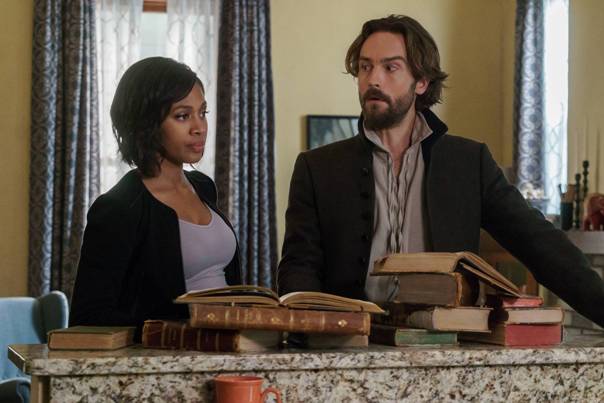
 So another season of Sleepy Hollow is nearly over. For fans of the show, it means that once again Fox will keep you waiting to know the fate of your obsession. But it also means something special to those of us who love those of you who love the Hollow, or in my case, Mrs. TV Recaps. Yay!
Anyway, here are some of my thoughts about the show in general and how it has affected our loved ones and households.
We admit it, we know way more about Abbie and Ichabod than we’ll ever let on. “What do you mean she is in that tree? WTF?”
We can’t always tell twistory from history. Benjamin Franklin really took air baths?
Dear #Sleepyheads, we’re Team #Ichabbie too. We want the writers to know that we’re about as tired of the teasing as you are.
We’re a bit amused by your frustration with the show. For even casual sports fans such as myself, it’s kind of nice to see you react the way we do to a penalty called against our favorite football team. Friggin’ Giants, man.
While we try to follow the plot, we are not always sure just what the heck is going on. We understood Headless, he made sense and he was a badass. But after that, it becomes a jumble of portals, monsters and mayhem.
It will be good having our partners’ undivided attention again on Friday nights. Oh, wait? You’re going to be in a chat? Rewatch parties? Oh, okay…
We’re deeply concerned. Honestly, if Fox doesn’t renew this thing, we think you’ll take up weird hobbies like taxidermy, making dog hats or creating emojis from dryer lint, and this is just plain no good for anyone.
So, I say, come on Fox, get it together and renew Sleepy Hollow. Now!
]]> This episode of StarTalkTV could have probably used a trigger warning of some sort. It was graphic, Aliens-graphic almost, but it was also one of the more feel-good things you could see.
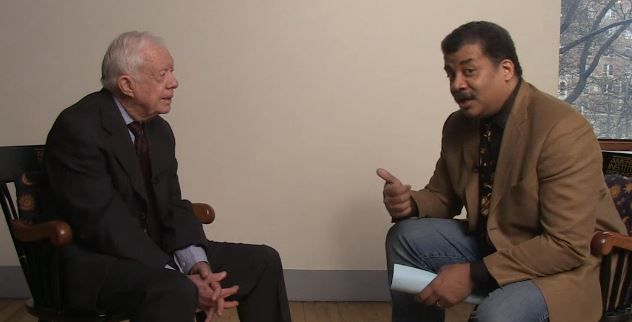
Why? Well, Neil deGrasse Tyson’s office guest this week was Jimmy Carter, the 39th president of the United States of America talking about despicable worms and the possible eradication of a dreadful disease from the planet.
Joining Tyson at the Hayden Planetarium were parasitologist Mark Siddall of the planetarium and comedian Chuck Nice. Siddall studies parasitic diseases and is working with The Carter Center, which among its humanitarian efforts, seeks to stop diseases, as shown at an exhibit at the American Museum of Natural History (home of the Hayden) called Countdown to Zero – Eradicating Eradicable Diseases.
The disease focused on in the exhibit is called Guinea Worm or Dracunculiasis. Nothing that sounds like Dracula is ever good and this is no exception. Those who easily find themselves freaked out by parasitic diseases might want to check out now, because there’s an actual worm and it’s actually in people, until it causes pain and suffering, and then it isn’t.
Does it suck? Back at the planetarium’s Hall of the Universe, Siddall explains that his job is to study parasites like leeches. Asked by Nice why he does this, he responds in best dad humor, “It doesn’t suck that bad.” Nice laughed hard; though I believe the in audience groans reached the edge of the galaxy.
It’s all in us: Siddall begins creeping us out when he discusses internal parasites and offhandedly mentions that “We’re the cans that other things come in.” Shudder.
Do the worm: Finally, the discussion turns to the Guinea Worm itself and why it needs to be extinct. Siddall explains that the parasite grows to 3 feet in length and has been with humanity for the past 7,000 years. How bad is this, well, it’s a Biblical plague for one. The worm completes its lifecycle by burrowing out of human legs and spitting its eggs into untreated water supplies. Siddall explains that it’s the only parasite that needs to inflict pain on people to continue its lifecycle. There are pictures shown, I won’t describe them, except to say: Arrrrrrrrgh.
Now the good news: Turns out that only humans get Guinea Worm disease. No humans, no Guinea Worm, he explains. Seems like an extreme solution, but what do I know?
A huge task: President Carter explains that the scope of fighting this diseases has been huge as it has required going to 20 countries and 23,600 villages since 1986. He says The Carter Center has been to them all. But the main point is to get the residents of these villages and the government s that support them to fight these types of disease themselves through education and prevention.
A long time coming: Siddall then explains what it is like to actually develop Guinea Worm disease (Mrs. Recapper, stop reading now). Basically this thing can take up to a year to grow, from an egg in the drinking water to 3 feet inside of the human body. In a brilliant, evil survival strategy, the worm causes so much pain that those suffering from it find the nearest water supply to cool the pain. The worm emerges (usually from a leg) and then gets to spread its young into the water supply. “These are dragons.” Siddall says speaking of the pain they cause.
Overcoming overconfidence: The issue in fighting a disease like this one is that to eradicate it, you have to get rid of all cases, Carter explains. Doing so would effectively kill the disease, since there’s no other way to transmit it. He says the biggest threats to progress are political instability and leaders who get overconfident as they see the number of cases drop and let down their guards.’
Naming your price: President Carter tells of how he needled Ghana into action. After the disease had dwindled there to a few dozen cases, from its peak of 126,000 cases, Carter said he felt the government wasn’t acting forcefully enough to finish it off. Exasperated, Carter used some chicanery, telling the president of Ghana they would change the name to the Ghana Worm if the efforts weren’t stepped up. There is no Guinea Worm in Ghana now. Nobody wants a disease named after their country, Tyson says.
The verge of success: What the episode boils down to is the fact that Siddall next mentions. There were 126 cases of Guinea Worm on the planet as of this episode’s airing. He later explains that there were 3.5 million cases of the torturous disease as recently as 1986.
Extinction ok: Would Siddall miss the Guinea Worm once it was extinct, Tyson asks. After all, what’s a parasitologist without parasites to study? Siddall explains that he’s sentimental about ending pain and suffering in humans rather than saving an organism. Since the worm depends on human pain for its survival, he’d be happy to see it go.
Bill Nye dogs New York: Bill Nye’s recorded bit was notable not so much because of what he says – the biggest challenges to human health are the microscopic ones like parasites – but what he does. Since the segments all feature him in an NYC location, this episode features him ordering and eating a NYC street hotdog. Whoa.
Chuck Nice goes for the laugh and gets it, saying “Half the stuff he talked about was on that hotdog.”
This will probably keep you up nights: Finally, Tyson asks Siddall about his remark earlier about humans being containers of other species. Siddall responds saying, “Where the human species stops and starts is very fuzzy…” Tyson stops him. “Wait. Say it again, but don’t freak me out.”
Clearly, pondering the final fate of the universe is a lot more comforting to Dr. Tyson than pondering the universe in the human body. Siddall breaks it down, explaining that the human body contains roughly 200,000 species of microorganisms. Basically, we’re them and they are us.
Not creepy at all, StarTalk. Not creepy at all.
]]> StarTalk TV goes to either the end of everything or the beginning of nothing, depending on your perspective.
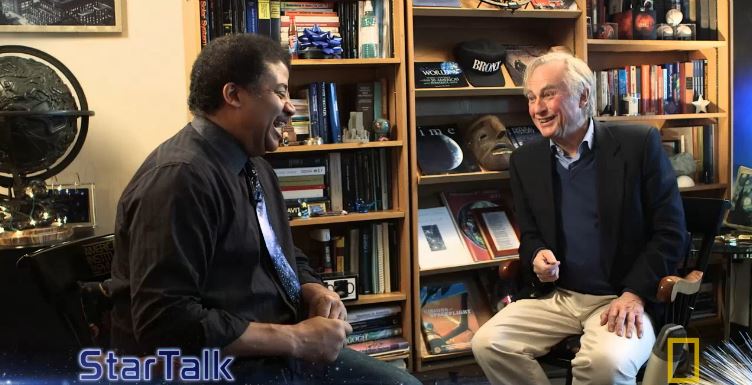
This episode was a natural follow to the Arianna Huffington episode in which she talked of the intersection of science and religion. Host Neil deGrasse Tyson seemed skeptical of her claim about a connection between religion and science. This episode featuring evolutionary biologist Richard Dawkins fully explored that divide.
Taking this trip to the collision of science and religion with him back at the Hall of the Universe were his guests, comic Eugene Mirman and Jesuit priest, Father James Martin (Full disclosure: I went to a Jesuit university and thought they did a good job of not messing me up).
So, where do science and religion converge and can they co-exist? Here’s some of the highlights from the episode.
Jesuits are keeping the world on track: Introducing Father Martin Dr. Tyson reminds us that they were behind the prosecution of Galileo for placing the sun at the center of the universe, but then also reminds us that the Jesuits also used science to create the Gregorian calendar, which actually keeps us from having years that are either too short or too long, as previous calendars did.
Logic might not always keep you from getting eaten: Talking to professor Dawkins in his office, the conversation contrasts religion and logic. Logical thinking didn’t always work out for ancestors, Dawkins explains since though it might be logical for survival, it wouldn’t have served man well to study a lion’s teeth the first time you encounter it.
Bouncers are the intersection of science and religion: Discussing whether science and religion are compatible, Tyson refers to Pope Francis, who, besides being the head of the Roman Catholic Church, also has a degree in chemistry and once served as a bouncer in Argentina. Clearly, if you’re in a bar fight about the periodic table, the pope’s your man.
Faith by degrees: Tyson asks how someone like the Pope can hold a scientific degree and believe in the spiritual realm. This is pretty much the crux of the rest of this episode. Martin responds that the searching for answers in science works as it’s a way of coming understanding God’s creation.
Tyson describes having a moment of looking down from a mountain on a night in which he could look down on clouds covering cities and feeling that it was spiritual, but not requiring a deity. Mirman remarks that, “You’re describing Zeus’ experience.”
Rules and regulations: Tyson says one of the major stumbling blocks for him isn’t finding the spirituality in nature, but the whole package of beliefs that come along with any religion. There’s a long discussion of rules, with Tyson explaining that science’s rules can be broken if they lead to greater truth.
Beliefs versus abilities: Back at the office Tyson and Dawkins explore whether belief in non-logical things should exclude someone from say, practicing medicine. Hey where’s Ben Carson when you need him?
Martin disagrees with the thought that such people could exist. Those who would hold such thoughts wouldn’t be scientists. Tyson challenges this, saying that he’s met scientists who disavow evolution.
Mysteries of deity: Martin says that certain parts of the sciences, such as quantum mechanics eventually lead to point where you have to accept something is happening, without an explanation. Tyson agrees that mysteries exist but challenges the notion that a deity is needed to cover the gap between science and mystery.
Science believers: When it comes to scientists that express belief in God, Dawkins explains that that pre-Darwin really had no choice. Those who came after Darwin frequently don’t believe all the tenents of religion or, as in Albert Einstein’s case, were expressing a belief in the divine as a metaphor for how the universe works. That leaves a small percentage that practice science and believe fully, of those, Dawkins says he just doesn’t understand them.
Martin says he too doesn’t understand how one can doubt evolution and, but that science doesn’t require abandoning one’s religious beliefs.
Bias battles: Perhaps the most contentious portion of the episode was when Dawkins described bias against atheists, pointing out that in the U.S. there’s no real use for atheist politicians. He also describes the difficulties for some young people expressing atheist beliefs in their communities and compares it to the experience of gay youths coming out of the closet.
Martin accepts this but warns against a bias he sees coming from the atheist community towards religious people who are considered “idiots” for believing.
Tyson points out however, that since atheists don’t run anything they don’t have the power to discriminate.
Finally the show closes with this enlightening bit of conversation after a short discussion of the idea of what God’s existence and proof would mean to science, with Dawkins, Martin adds that a deity at the beginning of the universe is the cause in scientific cause and effect. Tyson shoots back and quotes himself saying, “The universe is under no obligation to make sense to us.” Martin responds with a quick, “Neither is God.
]]> Sorry dear reader(s) this has taken me a few extra days to catch up one the latest episode of the best (only) late-night talk show hosted by a noted astrophysicist, StarTalk. I’d have done this sooner, but I was busy trying to lift heavy objects around Recappers’ HQ. Seriously, I’m pretty sure that second-hand sofa is heavier than Pluto.
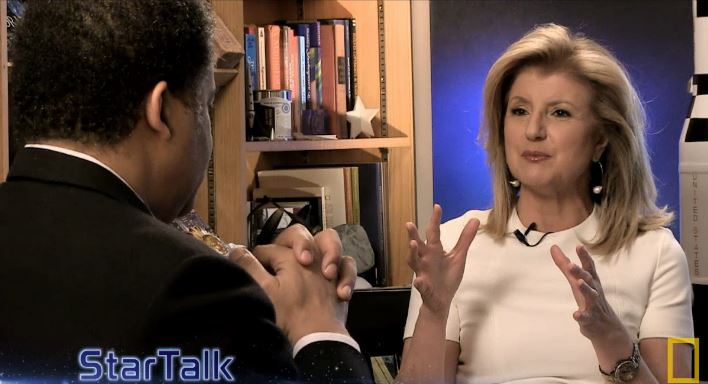
The featured guest was Huffington Post co-founder Arianna Huffington, who is celebrating the 10th anniversary of Huffpo. In the Hall of the Universe at the American Museum of Natural History’s Hayden Planetarium with Dr. Tyson were Jeff Jarvis, professor of journalism at the City University of New York and Chuck Nice.
The subject of the episode was blogging and media. Here are some highlights.
The End of Guttenberg? Tyson discusses the idea of how competing newspapers provided access to different types of news and were able to define communities in that way. Jeff Jarvis explains that because of technology we’re at the end of “mass” audiences the media can shovel information at. Some academics now believe that the current information age represents an end of the change in communication brought about by the invention of the printing press. Communication has returned to trying to spread word of an event or idea from one person to another with new tools such as blogs and social media leading the way.
Faith in bias or your fellow man? The conversation turned to the subject of bias. Nice pointed out that news outfits were often created around the publisher’s bias. But he wonders whether today’s individualized news is really just a chance for people to seek out only the “news they agree with.”
Jeff Jarvis chides Nice, saying, “O ye of little faith in your fellow man.” Nice comes back at Jarvis with, “I’m a comedian, I have no faith in my fellow man.” Comments like this make me think that science of laughter and comedy would make for a great future episode.
Aggregation aggravation? Tyson follows on the bias discussion to raise the issue of how those who dig up the news actually get paid if the Huffingtons of the world can just aggregate the work of others. Tyson puts the question to Huffington. Her response was that Huffpo and other aggregators should drive traffic back to the content creator which will result in investigative reporters getting paid.
Rumor has it: Tyson later asks how if there are now so many more potential news sources (everyone online) how does a reader determine the true story? It’s the journalist’s job to help point that out, Jarvis says. Nice then asks, “Have you seen Fox News?” This leads to one of the best moments of the episode as Tyson turns to the camera, laughs and says “Fox is the majority owner of National Geographic Channel.” Nice tries to deftly deflect from the subject and laughter ensues. Hope Chuck cashed the check from that episode quickly.
Barbarians at the gatekeeper: Jarvis adds later that though journalists are tasked with separating rumor from fiction, they’re no longer the filter or gatekeeper for information handed to the public. Search engines like Google can use what they know about what’s being considered most reliable by readers. Tyson then asks about why non-scientifically accurate views can get pushed to the top of a search engine because of interest from those parties. Jarvis argues it is the job of the true scientists to create more content that will drive the bad information lower in search rankings. Man, I hope Jeff Jarvis is right here, else we’ll be back to learning how flat the earth is.
Science vs. religion: Huffington is back and Tyson asks her about science, which leads her to talk about how she believes her initial interest in religion and spirituality led her to consider the common trait in both science and religion: wonder. Tyson grants her the intersection of wonder, though you sense he’s being a bit reserved. Back at the Hall of the Universe, he puts it more directly, saying that that they can’t really be compared since religion makes claims that can’t be tested.
Overall, it was an enjoyable enough episode. Since this is a subject that I know a good deal about from my work in new and social media, perhaps I was expecting too much. For instance, though they touched on trolling as a phenomena, they didn’t explore either why trolls do what they do or examine why news sites are so frequently beset by trolls. StarTalk, for me, is best when it starts exploring the mechanics of a given subject and I felt a bit geek deprived. Hopefully there’ll be an episode that will examine the biology and psychology of human communication. I’ll look forward to that episode. Meanwhile, I’m going to rest my back.
Oh, and congratulations to Neil deGrasse Tyson and Star Talk for getting a second season. Thanks for not making me start a fan campaign to keep you on the air!
]]>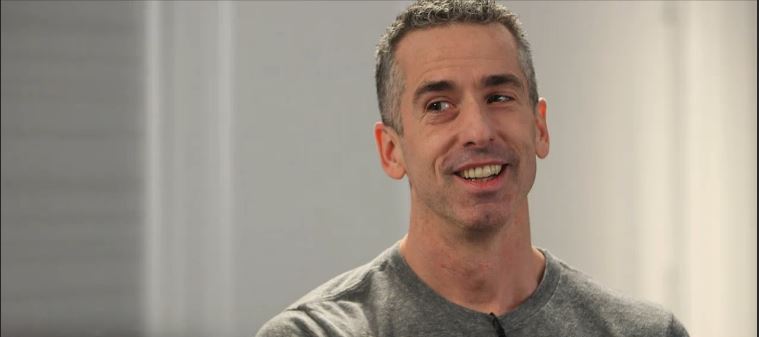 Last week’s StarTalk was interstellar, this week’s was interpersonal. Neil deGrasse Tyson, comic Chuck Nice and biological anthropologist Helen Fisher riffed on this week’s taped segments with sex and advice columnist Dan Savage and got deep into how and why humans meet and mate.
The episode wasn’t the most scientifically interesting, but it showed where the show is headed. Tyson is a little more settled in his approach, less jumpy, more ready to listen to his guests before jumping in. Now, that might have something to with the subject matter. Something tells me that while the good doctor can easily navigate the stars, he, like most of us guys, is just wandering through the world of love and lust trying not to break anything in the room.
Here are some highlights from Monday’s show:
One-night stands are a part of our wiring: Fisher explains that 30% of long term relationships were the result of one night stands and 60% of Americans have had a one-night stand. In Tyson’s taped segment with Savage, the guest explains that people meet in a variety of non-romantic comedy ways, including rehab or even “the drunken three-way where someone fell in love with the ‘guest.’ ” These are not the stories that get told to friends and family.
A good story can get in the way of love: Tyson points out that by whitewashing these stories we wind up ostracizing those who don’t meet that way. Even worse, according to Savage, the shame attached to these meetings makes people devalue those they slept with. “They think no decent relationship can have a sleazy start,” Savage says. Sheesh. Isn’t love hard enough without needing a good story?
Biology turns lust to love: Fisher explains research has shown that stimulation of genitals drives up the dopamine system and can “push you over the threshold into falling in love.” Sex is a drug, Nice says. Fisher adds that romantic love is an even bigger drug.
Love at first sight is all right: Fisher comes back after a Savage segment in which he disputes the veracity of love at first sight, and explains that our brains register feelings of love instantly, the same way that they register fear. She adds that we often head straight to sex to confirm those feelings.
“You learn a lot about someone between the sheets,” Fisher says. Tyson blurts out, “Or on the pool table.” He quickly adds, “Did I just say that?” Something tells me that Dr. Tyson, besides being a science stalwart, is someone’s crazy uncle.
Pay the price: In the next segment, Tyson asks Savage about the elements of a successful relationship. Savage points out that what he notices in the correspondence addressed to him is that there are people who are obsessed with the faults of their partner. He points out that everyone has an annoying habit or trait, but that success is more likely if you are willing to “pay the price of admission” and focus on the positive.
Monogamy isn’t natural, but it’s possible: Monogamy isn’t really found in our biology or that of other animals, Savage says. Even many of the birds we thought mated for life turn out to have hopped nests once in a while. He explains there is social monogamy and sexual monogamy. While he points out that he doesn’t oppose monogamy, but that he thinks there should be compassion for the fact that it’s nowhere near as easy as we expect it to be.
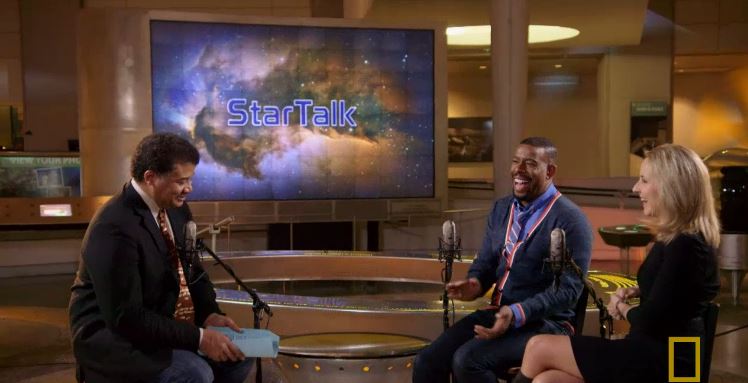 Sorry, Angelina: Fisher later discusses the male brain and how it has evolved to be highly visual. She cited a study where they placed men in MRIs and showed them photos of their wives to see how the brain responded when asked to think about love, not sex. The scans showed lots of extra positive activity. Interestingly, a man who asked to be shown Angelina Jolie and then his wife showed a lot more brain activity when looking at his wife than when looking at the actress. Fantasies are strong; happy memories, feeling and perceptions are stronger, Fisher says. “He had no problem getting laid after that,” Nice says. Fisher responds, “We did him a service.”
Not a matter of will: When it comes to the brain, there are very big differences between men and women, Savage says. He cites cases of how females taking testosterone reported changes in their thoughts and fantasies. Tyson then tells the story of a colleague who transitioned from male to female. The colleague realized that she responded to situations different now and was aware of the difference but felt so compelled to act in a certain way that she “began to question free will.”
Bill Nye the Horny Guy? Tyson asks, “Don’t you want to know what Bill Nye the Science Guy thinks about sex?” We say no, but Nye tells us anyway. Speaking from the Museum of Sex, Nye explains that we tend to think of animals treating sex as the business of making more animals. Truth is science has shown that the birds and the bees are enjoying it, too as they pass their genes on. He finishes saying, “All this talk about sex is making me hungry, wait, that’s not what I meant, all this talk about sex is making me horny.”
Tech titillations: Talking to Savage again, Tyson asks about apps like Tindr (this is like the third mention of the site, just saying) and explains that the inventors of the GPS never anticipated that their tech would be used to help strangers hook up for sex. Savage explains that new technology always moves first towards sex and romance. Phones were scorned because young men could call someone’s daughters; cars allowed couples to be alone, he says.
Finally, Tyson asks Fisher if love interferes with intelligence. “Yes” she says, “love makes you stupid.” Well, if that’s the case, I say, viva le dumbness (Mrs. Recapper I’m looking at you).
]]>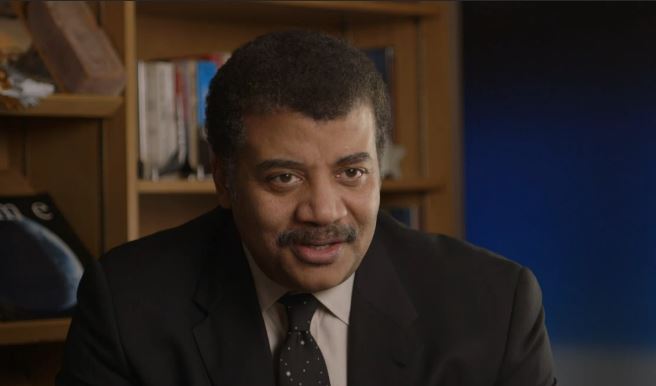 On this week’s StarTalk, the leap is from the final frontier to the outer limits of man’s perception. StarTalk host Neil deGrasse Tyson and guests take a look at the depths of space and time via a conversation with Interstellar director Christopher Nolan.
Tyson’s guests this week included comedian Eugene Millman and cosmologist Janna Levin.
The episode tracks closely with the format of last week’s premiere. Dr. Tyson’s got a lot to say, but the guests eventually manage to get their moments in. Here are some highlights from this week’s episode:
Math is not Christopher Nolan’s bag: Asked why he has played with time and space in his movies, Nolan explains that the original Cosmos TV show spurred an interest in science and curiosity about the universe. Math, however, got in the way of Nolan’s scientific pursuits, a sentiment I can completely relate to. Back at the hall in the Hayden Planetarium, Tyson adds, “One doesn’t need to be mathematically fluent to bask in the majesty of the cosmos.”
Dr. Levin explains that what makes math great is that you get to “follow the chalk” because one idea on a chalkboard follows another.
Man, if someone had put it to me that way when I was a kid, I might not have turned out to be a mathematical nitwit.
Science to the stars: The discussion turned to the idea that science could take us to other planets. Millman asks if we can go to Jupiter. Tyson puts that idea on ice, saying it would be great except for the “radiation fields that would cook your gonads.” Yep, count me out of that Jupiter mission.
Next up with Nolan is a discussion of why his films so frequently mess with space and time. He explains that the concept of a beginning, middle and an end isn’t necessarily true to how we tell stories or even how they happen. Being able to use science to change how stories are told is something that appeals to the director.
Black holes will screw up your iTunes: Due to its gravitational pull, time slows so much near a black hole that if you manage not to get sucked in and go back home, Levin says everyone you knew would be much older than when you left. Millman points out that in that case “all of your favorite bands are gone.” Sorry One Direction fans, but I’m sure Stephen Hawking can help you fix this.
Time travel might not be the death of you: The discussion of time leads to a lengthy discussion of whether someone could go back in time and interrupt his or her own birth. Levin says Albert Einstein’s theory of relativity could make this possible though unspecified forces might prevent you from killing your parents and ending your own existence. This is all sounding pretty familiar when Mirman breaks up the Tyson-Levin geek out, saying, “We can pretend that you’re not, but you’ve just described Back to the Future.” Millman, FTW.
Hollywood has a wormhole advisor: Back to the interview, Tyson asks Nolan about a fellow scientist who advised on and helped refine the plot of Interstellar. Tyson quips, “He’s a wormhole guy. He’s mister wormhole. He put the wormhole in Contact.
Wormholes aren’t nearly as neat as warp drives: Wormholes aren’t holes, explains Levin, but spheres that can be entered from any direction. Whoa. It apparently takes forms of matter and energy we don’t yet have access to create and open a wormhole. It takes lots of that stuff, she adds. Warp drives, however, are more efficient and, Levin says, would make crossing space and time to get to other planets much simpler.
Black holes suck, but not as bad as you think: Levin explains that while black holes do slow down time due to their immense gravitational pull, they wouldn’t eat everything. Even replacing the sun with a black hole (Soundgarden anyone?) would just create a cold, unpleasant world, not a vacuum of destruction. Levin adds that this just a “false reputation.” Tyson jokingly refers to Levin as the “PR agent for black holes”. Levin follows up by adding that all stars have strong gravitational fields, even our favorite. “The sun is sucking us up, just incredibly slowly,” she says. The good news, Tyson says is that we’re much more likely to make ourselves extinct before getting sucked up by the sun.
Love the one you’re with: Bill Nye’s video segment this week points out the flaw with all science fiction that focuses on travel to other planets, such as Interstellar, which looks at efforts to find a new home for humanity. Waiting on a solitary NYC subway platform, he reminds us that other planets aren’t going to be a better earth than the one we’ve got. If we were ever so technically advanced, he suggests we might be better off just making a better earth, something we might want to work on now. Oh, and it hasn’t rained on Mars on 3 billion years.
All in all, this was a good episode. Clearly the transition from radio is still being made. Tyson’s less antsy coming out of the commercial breaks, but they still might need a seatbelt to keep him on that stool. Still, it’s an entertaining and enlightening hour.
]]>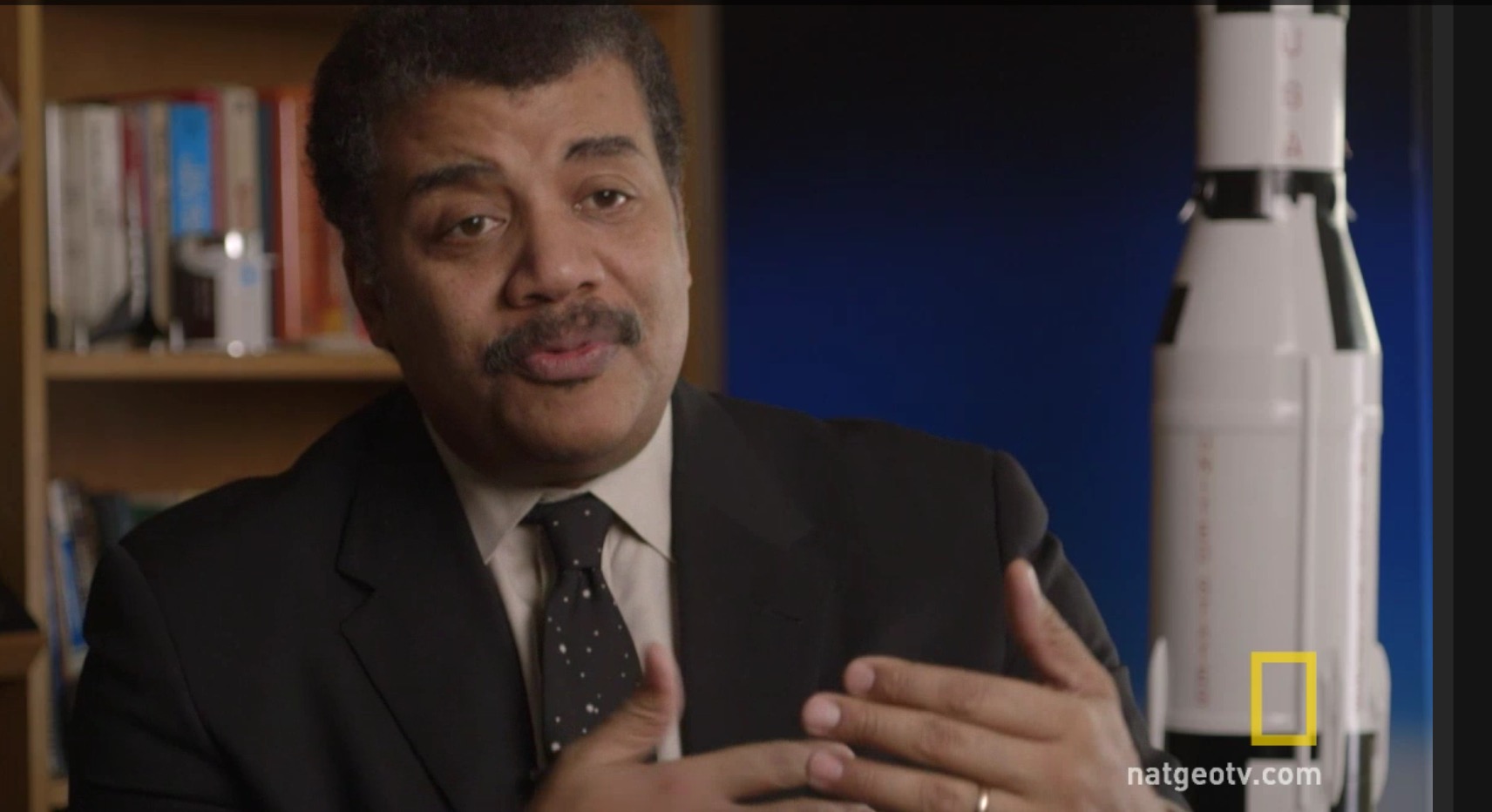 After displaying The Royals for seven hours in a row, our DVR was showing signs of depression. To preserve this key piece of household equipment, I took the remote away from Mrs. TV Recaps and decided to perform an emergency viewing of something completely different. So, here goes my recap of StarTalk with Neil deGrasse Tyson. Hope you enjoy it.
What’s the best way to get Americans interested in science? Well, besides paying them all and perhaps taking away their cable, you might want to try and figure out a way to marry their love of pop culture with deep thoughts about science, technology and the human condition. You’ll want someone comfortable in his own skin, engaging, erudite, and yet able to sling the occasional expletive (preferably 4 minutes into the program). Impossible, you say? I say check out StarTalk which premiered on National Geographic last night.
A companion to Neil deGrasse Tyson’s very popular StarTalk Radio podcast, the show takes that format and makes itself TV friendly. For those of you that don’t speak geek, the astrophysicist and director of the Hayden Planetarium in New York City explains midway through the premiere: “It is our job to collide pop culture with science. If we don’t do that, we’re not doing our job.”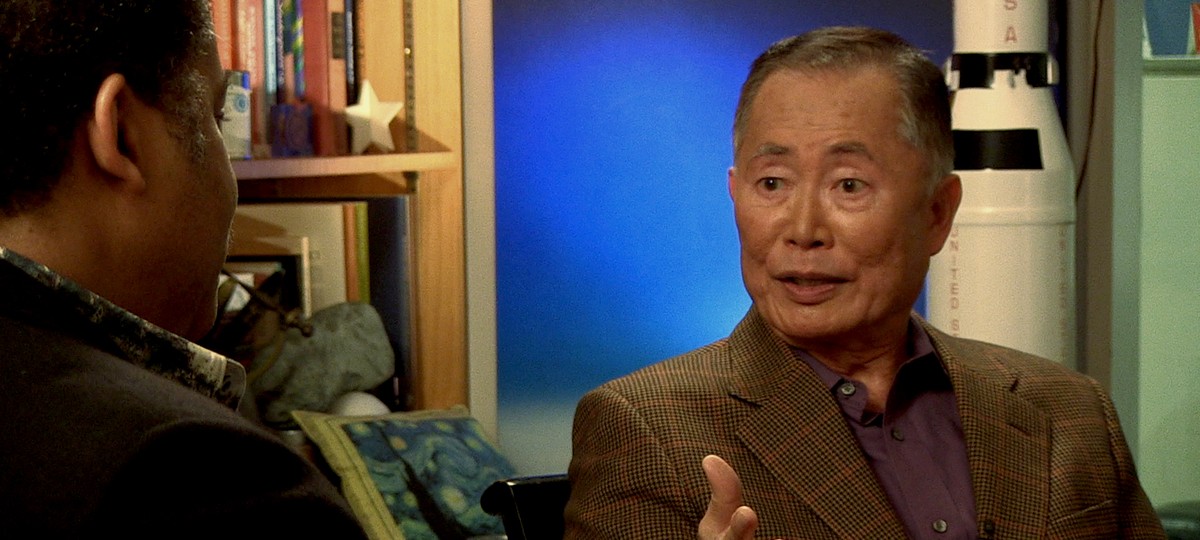
What better way to start that collision than with an examination of TV’s historic Star Trek, the show that inspired geek souls everywhere. The show centers on segments of a conversation Dr. Tyson had with George Takei, whose Hikaru Sulu was helmsman for the starship USS Enterprise.
Those segments get discussed with Tyson’s in-studio guests: comedienne Leighann Lord and astrophysicist and “all around smart guy” Charles Liu. Unlike most late night shows, no one is plugging a program, album, movie or appearance. Everyone seems to be here to push knowledge – never a bad thing. The tone is frequently light and though seated on a stool, Tyson is frequently a body in motion, with his hands and arms and head moving for emphasis. That’s not a criticism though, as some of us have been known to gesticulate a bit when enthused… Ahem.
Anyway, here are some things I took away from last night’s StarTalk.
- StarTalk might have its head in the stars, but it’s got human roots: The first several segments of the Takei interview focused on discussed matters of diversity and race, contrasting Star Trek bold multicultural/multi-species outlook with the painful past and present of America. George Takei movingly talks about the horrific moment his family was interred during World War II and the frightening aftermath when his family was dumped into L.A.’s Skid Row. The commentators point out how that period in U.S. history was the opposite of creator Gene Roddenberry’s Star Trek vision.
- Keep your communicator, and maybe your transporter, too. While chatting with George Takei about the technology that Star Trek predicted, the astrophycist points out that the while the Trek communicators were cutting-edge in the late ’60s, no one today would want a device that just lets you talk. Later, he adds that transporters would be cool to avoid traffic and move goods, but he wouldn’t want to be the first to travel via one. Tyson understands self-preservation. Leighann Lord also points out the scary thought of uninvited dates showing up at your home.
- We could build an Enterprise-ish: While chunks of the technology needed to build the Enterprise and cruise space don’t exist, there are equivalent technologies that could be pressed into service, Tyson says, citing a Gizmodo article. He adds that carving out a portion of the U.S. defense budget could fund such an endeavor. At this point he nearly jumps out of his seat with excitement. Inside that cool, grown science icon is a joyful geek child.
- Neil deGrasse Tyson sometimes gets it wrong: In a great moment, the host describes how he had long screwed up his description of how the Enterprise’s warp drive would work using his astronomical patterned tie. Luckily, he was set straight in an alley by some Trek fans at a Comic-Con. Dr. Liu is displeased that his fellow astrophycist and sci-fi fan could get it so wrong and mocks him a bit.
- I’m putting wine in a blender: The talk turns to food on the Enterprise and Dr. Tyson mentions an experiment done with putting wine in a blender to improve the taste and the molecular implications behind that. I’m not sure exactly how this works, I just know that it sounds cool and I’m giving it a try. Stand back.
The show closes out with Tyson’s science-bro Bill Nye in a filmed segment. Honestly, a my thoughts turn to the epic rap battle featuring Sir Issac Netwon, Nye and Tyson. But Nye nicely bookends the show’s premiere by explaining how Star Trek, unlike much of today’s SciFi, had an optimist view of the future and one worth keeping in mind.
As a low-level science geek, I’ll be a little more optimistic about the state of television and humanity if a show as smart and good natured as StarTalk finds a long-term home on TV.
]]>How do I know that? Because I’m happy to announce that our own Elaine F. will be making her storytelling debut at the Cornelia Street Cafe in NYC this coming Tuesday, April 14 at 6 p.m. as part of the New York Story Exchange.
If you’re in the area, join us in Greenwich Village and cheer Elaine on as she tells a tale of derring do, or at least a tale of doing something.
Here’s the poster for details. See you there!

]]>